

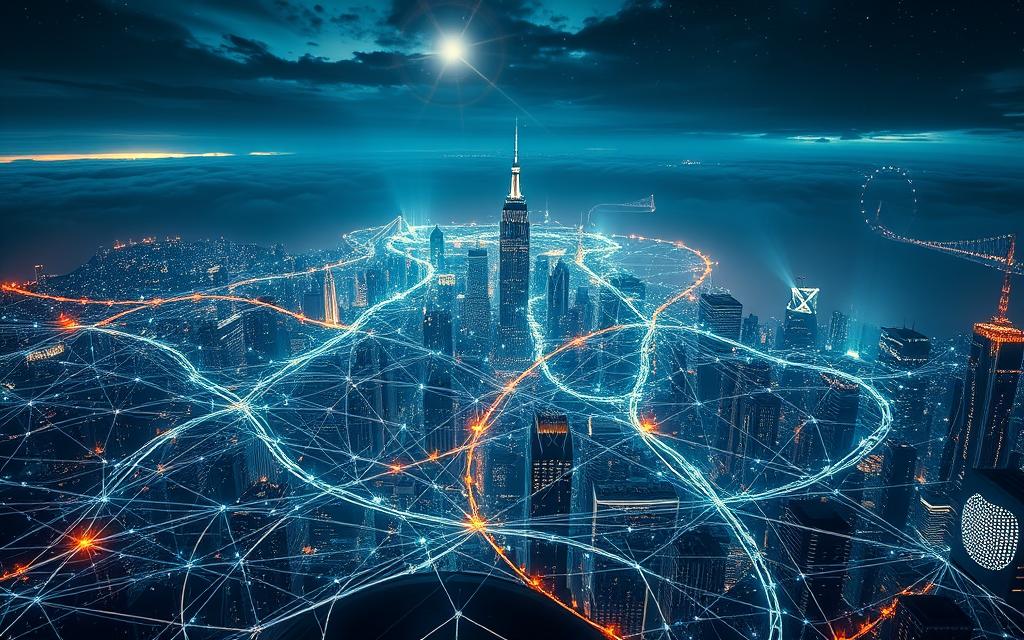
Our lives today are linked by a vast digital network that crosses continents. This global digital network is a testament to humanity’s greatest achievement in communication.
Digital advancements have grown faster than any technology before. In just 20 years, they’ve reached over half the developing world’s people. Now, more than 73% of the world’s population is connected through this system.
The internet’s worldwide connectivity has changed societies and economies. It connects countless devices across the globe using the TCP/IP protocol suite.
This technological leap brings both great benefits and big challenges. It speeds up progress towards global goals but also raises concerns about privacy, security, and fairness for all.
The digital age is changing fast. Grasping its internet impact helps us better understand and use this connected world.
The Evolution of Global Digital Connectivity
The shift from isolated computers to today’s connected world is amazing. It has changed how we talk, work, and find information globally.
From Early Networks to the Modern Internet
The history of internet started with packet switching in the 1960s. People like Paul Baran and Donald Davies laid the groundwork for fast data sharing.
The ARPANET and early packet switching foundations
In 1969, ARPANET was the first network to use packet switching. It linked computers at four US research places, showing data could be sent and put back together.
The Internet Protocol Suite (TCP/IP) in 1982 made networks talk to each other. This was key for the internet we use today.
Related Posts:
- How Technology Changed the Way We Live A Social and…
- How Long Has Information Technology Been Around The…
- What Does Technology Mean in Economics A Driver of…

- How Technology Improves a Business Streamlining…

- What Does an IT Professional Do Roles and Daily…

- How to Implement New Technology in an Organization A…

The birth of the World Wide Web and its global impact
The World Wide Web made the internet for everyone. In 1990, Tim Berners-Lee at CERN created HTTP, HTML, and the first web browser.
- HTTP (HyperText Transfer Protocol)
- HTML (HyperText Markup Language)
- The first web browser
By 1995, the internet was open to all in the US. It quickly spread to homes and businesses worldwide.
Mobile Revolution and Wireless Advancements
The mobile technology evolution has changed how we use the internet. Now, mobile devices are used for almost 60% of web traffic. 96% of users access the internet through their phones.
From 1G to 5G: Transforming mobile connectivity worldwide
Mobile networks have evolved greatly:
- 1G (1980s): Only for voice calls
- 2G (1990s): Added SMS
- 3G (2000s): First mobile internet
- 4G (2010s): Fast mobile broadband
- 5G networks (2020s): Ultra-fast, reliable connections
Each step has made mobile internet much faster and better. 5G networks are up to 100 times quicker than 4G, enabling new tech like self-driving cars and remote surgery.
Wi-Fi and satellite internet technological breakthroughs
Wi-Fi has made local wireless networks in homes and offices. Satellite internet has reached remote areas, making the internet available everywhere. This supports the goal of global digital inclusion.
These technologies work together for smooth internet use. They have made mobile internet use the norm today.
Infrastructure Enabling Worldwide Connections
Our world is connected thanks to advanced infrastructure. This includes physical and wireless networks that make up the internet we use every day.
Undersea Cables and Fibre Optic Networks
Under the sea, a vast network of undersea cables carries most of our international data. These cables are key to our global communication system.
Global submarine cable systems connecting continents
Submarine cables stretch across oceans, linking continents with fast data links. These cables are huge investments in our internet infrastructure.
New projects are adding to this underwater network. They bring faster internet to more places and improve existing connections.
Fibre optic technology and exponential bandwidth growth
Fibre optics use light to send data, making it fast. These thin glass strands carry a lot of information quickly.
Thanks to fibre optics, our internet speed has grown a lot. Now, cables can send hundreds of terabits per second across oceans.

Satellite Systems and 5G Deployment
Satellites are important for areas without cables. They help connect 2.21 billion people worldwide who lack internet.
Geostationary and low-earth orbit satellite constellations
Older satellites orbit high, covering a lot but with slow speeds. New satellites orbit lower, giving faster speeds and better coverage.
Companies like Starlink use many small satellites to create networks. These networks aim to bring internet to the most remote places.
5G network global rollout and its capabilities
5G is the latest in mobile networks. It’s much faster and has less delay than before.
5G supports more smartphones, with 250 million new ones each year. It makes things like self-driving cars and remote surgery possible.
| Technology Type | Primary Use | Speed Capacity | Global Coverage |
|---|---|---|---|
| Undersea Fibre Optics | International data transfer | 100+ Tbps | Coastal regions |
| Geostationary Satellites | Broadcast and remote access | 100 Mbps | Nearly global |
| LEO Satellites | Global internet access | 150+ Mbps | Complete global |
| 5G Networks | Mobile connectivity | 1-10 Gbps | Urban areas |
These systems work together to make our digital world better. They help us stay connected, no matter where we are.
Social and Cultural Transformation Through Technology
Digital connectivity has changed how we interact and cultures evolve. The internet does more than share information. It has deeply affected human relationships and cultural understanding worldwide.
Breaking Down Geographical Barriers
Technology has removed old distance barriers. Now, people connect across continents as easily as with neighbours.
Real-time communication across time zones and borders
Today, we can talk instantly, no matter where we are. Video calls, messaging apps, and platforms make conversations easy, no matter the distance.
Business meetings happen across time zones. Families stay in touch daily, even if they’re far apart. This has changed personal and work relationships.
Virtual communities fostering global relationships
Online spaces have created new social groups. These groups are based on shared interests, not where you live.
Forums, gaming groups, and social media connect people from different cultures. They offer support and friendships that cross old boundaries.
Recent data shows the internet’s impact. With 5.66 billion active social media users, nearly 70% of the world is connected. These platforms are key to our social lives.
People visit nearly seven social media sites a month. They spend over 18.5 hours a week online. This shows a big change in how we spend our time.
Cultural Exchange and Global Awareness
Digital networks have opened up new ways to understand and appreciate cultures. The internet is a global museum and meeting place.
Access to diverse perspectives and international media
Now, we can experience cultures through digital content. News, films, and music from around the world offer real cultural insights.
Social media lets us talk directly with people from other cultures. We learn about international events and practices firsthand. This helps break down stereotypes and builds real understanding.
Digital preservation and sharing of cultural heritage
Technology helps protect cultural heritage. Digital archives keep traditions, languages, and arts alive.
Museums and cultural centres worldwide share their collections online. Indigenous communities use digital platforms to share and revive their traditions. This ensures cultural knowledge is passed on to future generations.
The social impact of internet connectivity is both good and bad. It enables great cultural exchange, but can also spread misinformation.
Despite the challenges, the internet’s effect has been overwhelmingly positive. It has enriched our global society through shared understanding and connection.
Economic Implications of the Digital Network
The global digital network has changed the way we do business and trade. It has opened up new chances but also brought new problems. This change affects everything from small shops to big international deals.
Global Business and E-commerce Revolution
The digital economy has changed how companies work across the world. Now, businesses can sell to customers all over the globe without spending a lot on setting up.
Remote work and distributed international teams
Companies can now hire people from anywhere without worrying about where they are. This means they can find the best talent and save money.
Teams work together online, breaking down old office walls. This way of working is flexible and keeps everyone productive.
Cross-border digital marketplaces and trade
Online shops have made it easy to buy things from other countries. This has made international shopping more popular than ever.
In 2025, people spent an estimated US$3.66 trillion online. This shows how big the online shopping world is getting.

Studies show 56.5% of internet users buy things online every week. This shows how common online shopping has become.
Innovation and Digital Economy Growth
The digital network is a big help for new ideas and business growth. It’s a place where new ways of doing things and new technologies can thrive.
Startups with immediate global reach
New companies can start selling worldwide right from the start. Online platforms make it easy for them to reach customers everywhere.
This means new ideas can spread fast across different places. Startups can grow without needing a lot of physical space.
International collaboration in research and development
Scientists and engineers from all over work together on new technologies. They use online spaces to work together in real time.
This teamwork makes finding new solutions faster in many fields. It helps research places share ideas and resources.
| Economic Aspect | Pre-Digital Era | Current Digital Landscape | Projected 2030 Impact |
|---|---|---|---|
| Job Creation | Localised opportunities | Global remote positions | 24 million new jobs |
| Market Access | Regional limitations | Instant global reach | Borderless trade expansion |
| Automation Impact | Minimal displacement | Growing AI integration | 800 million jobs at risk |
| Innovation Cycle | Years to market | Months to global adoption | Weeks for implementation |
The move towards automation brings both good and bad news. It creates new jobs in new fields but also takes away old ones.
This big change means we need to help workers adapt. Training and safety nets are key for growth.
The digital network’s impact goes beyond just making things easier. It’s changing how we do business and trade around the world.
Shaping a Connected and Equitable Digital Future
The digital network has changed our lives, work, and how we meet. It boosts the economy, shares cultures, and connects us across the globe. This tool links us in ways we never thought possible.
But, we face challenges. Almost three-quarters of people are online, but 2.21 billion are not. Technology can also harm privacy and widen gaps. We need a global effort to solve these problems.
We must work together to improve digital access. Using sustainable tech is key for lasting benefits. This summary highlights the need for fair policies and worldwide cooperation. By joining forces, we can create a digital world that’s fair for everyone.
FAQ
What is the global digital network?
The global digital network is a system of digital technologies. It includes the internet, mobile networks, and satellite systems. It connects over 73% of the world’s population.
FAQ
What is the global digital network?
The global digital network is a system of digital technologies. It includes the internet, mobile networks, and satellite systems. It connects over 73% of the world’s population.
How did the internet evolve into what it is today?
FAQ
What is the global digital network?
The global digital network is a system of digital technologies. It includes the internet, mobile networks, and satellite systems. It connects over 73% of the world’s population.
FAQ
What is the global digital network?
The global digital network is a system of digital technologies. It includes the internet, mobile networks, and satellite systems. It connects over 73% of the world’s population.
What infrastructure supports global internet connectivity?
FAQ
What is the global digital network?
The global digital network is a system of digital technologies. It includes the internet, mobile networks, and satellite systems. It connects over 73% of the world’s population.
FAQ
What is the global digital network?
The global digital network is a system of digital technologies. It includes the internet, mobile networks, and satellite systems. It connects over 73% of the world’s population.
How does technology break down geographical and cultural barriers?
FAQ
What is the global digital network?
The global digital network is a system of digital technologies. It includes the internet, mobile networks, and satellite systems. It connects over 73% of the world’s population.
FAQ
What is the global digital network?
The global digital network is a system of digital technologies. It includes the internet, mobile networks, and satellite systems. It connects over 73% of the world’s population.
What are the economic impacts of the digital network?
FAQ
What is the global digital network?
The global digital network is a system of digital technologies. It includes the internet, mobile networks, and satellite systems. It connects over 73% of the world’s population.
FAQ
What is the global digital network?
The global digital network is a system of digital technologies. It includes the internet, mobile networks, and satellite systems. It connects over 73% of the world’s population.
What is the digital divide and why is it significant?
FAQ
What is the global digital network?
The global digital network is a system of digital technologies. It includes the internet, mobile networks, and satellite systems. It connects over 73% of the world’s population.
FAQ
What is the global digital network?
The global digital network is a system of digital technologies. It includes the internet, mobile networks, and satellite systems. It connects over 73% of the world’s population.
How does 5G differ from previous mobile network generations?
FAQ
What is the global digital network?
The global digital network is a system of digital technologies. It includes the internet, mobile networks, and satellite systems. It connects over 73% of the world’s population.
What role do satellite systems play in global connectivity?
FAQ
What is the global digital network?
The global digital network is a system of digital technologies. It includes the internet, mobile networks, and satellite systems. It connects over 73% of the world’s population.
How does the digital network support the UN’s Sustainable Development Goals?
FAQ
What is the global digital network?
The global digital network is a system of digital technologies. It includes the internet, mobile networks, and satellite systems. It connects over 73% of the world’s population.
What are the ethical challenges associated with global digital connectivity?
FAQ
What is the global digital network?
The global digital network is a system of digital technologies. It includes the internet, mobile networks, and satellite systems. It connects over 73% of the world’s population.