
The journey of information technology is one of humanity’s most amazing changes. The term “information technology” was first used in a 1958 Harvard Business Review article. But, our use of data goes back thousands of years.
In ancient times, like the Sumerians in Mesopotamia, people created writing systems around 3000 BC. This was the start of our organised way to store and share knowledge.
The IT evolution has seen many breakthroughs. From clay tablets to cloud computing, each step built on what came before.
Knowing this digital age timeline shows us how far we’ve come. It also gives us insight into what technology might bring next in our history of information technology.
Ancient Origins of Information Technology
Before silicon chips and digital screens, people found clever ways to handle information. From 3000 BC to 1450 AD, they created key historical IT tools. These early tools show that information technology has deep roots.
Early Tools for Data Recording
Early societies needed to record and calculate information. Their solutions were simple but groundbreaking in early data storage and processing.
The Abacus and Tally Sticks
In Babylonia around 2400 BC, the abacus was invented. It was a device with beads on rods for quick math. It helped merchants and officials do math fast and accurately.
Before the abacus, tally sticks were used. These were notched bones or wood for tracking numbers. They were the start of managing numbers.
Writing Systems and Scrolls
The Egyptians created writing systems that changed information technology. Papyrus scrolls replaced clay tablets, making records easier to carry.
Related Posts:
- How Technology Connects Us to the World The Global…

- How Technology Changed the Way We Live A Social and…

- How Technology Improves a Business Streamlining…

- What Does an IT Professional Do Roles and Daily…

- What Does Technology Mean in Economics A Driver of…
- How to Implement New Technology in an Organization A…
This change made storing information permanent. Scribes could write laws, histories, and science more efficiently. Scrolls were key for centuries.
The Antikythera Mechanism
The Antikythera mechanism is a marvel among ancient computing devices. Found in a shipwreck from the 1st century BC, it amazes scientists.
An Ancient Analogue Computer
This device had gears and dials for predicting the sky. It could even track the moon’s orbit, a feat not seen again until the Renaissance.
This device was the world’s first known analogue computer. Its complexity shows ancient societies were more advanced than thought. The Antikythera mechanism shows ancient roots of complex information processing.
The Mechanical Age and Early Computation
The shift from ancient tools to mechanical computers was a big leap in tech. Between the 17th and 19th centuries, inventors made devices that paved the way for today’s computers.
17th and 18th Century Innovations
This time saw the making of advanced machines that could do math on their own. These machines showed how mechanical systems could tackle tough math problems.
Blaise Pascal’s Pascaline
In 1642, French mathematician Blaise Pascal created the Pascaline, an early mechanical calculator. It used gears and wheels for addition and subtraction.
The Pascaline was a big step forward in calculation tech. It could handle up to eight digits, making it great for finance and science.
Jacquard’s Loom and Programmable Patterns
Joseph Marie Jacquard’s loom, introduced in 1804, changed textile making with its programmable patterns. It used cards to weave complex designs.
The idea of using cards for programming was key to early computing. Jacquard’s work showed how machines could follow set instructions.
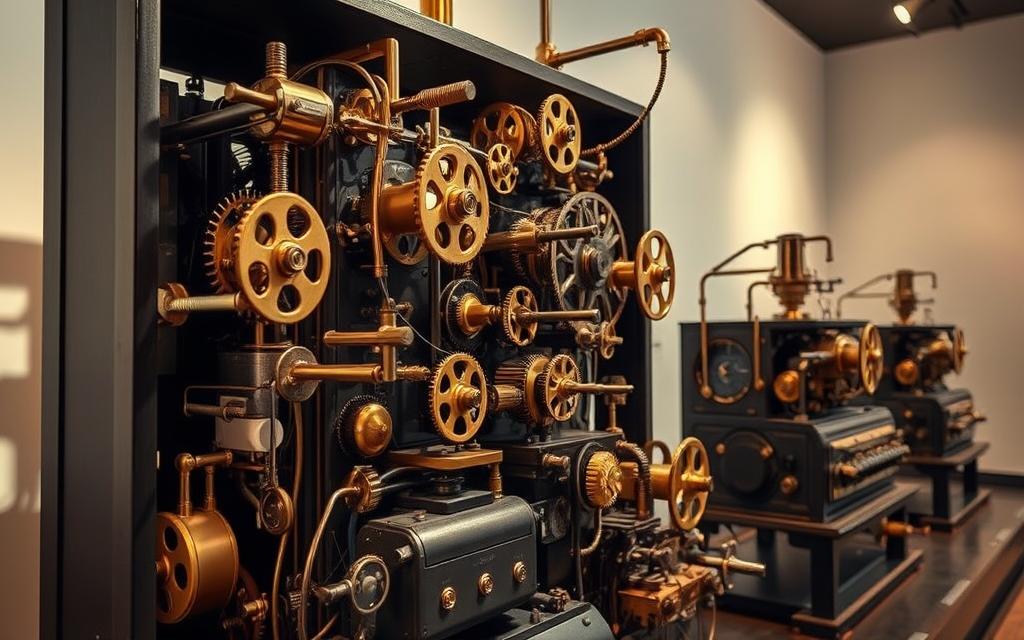
Charles Babbage and Ada Lovelace
Charles Babbage and Ada Lovelace teamed up to create ideas that shaped computing for ages. Their work laid the groundwork for machines that could be programmed.
The Analytical Engine Concept
In the 1830s, Charles Babbage designed the Analytical Engine, seen by many as the first general-purpose computer. It had parts similar to today’s computers.
The Analytical Engine had an arithmetic logic unit, memory, and flow control. Babbage’s designs, though never built in his time, showed the path for future computers.
First Computer Programmes
Ada Lovelace translated and expanded on Italian mathematician Luigi Menabrea’s work on Babbage’s Analytical Engine. Her notes are seen as the first computer programmes.
Lovelace wrote algorithms for the machine to calculate Bernoulli numbers. She showed its ability to do more than just math. She saw computers as tools for creativity, not just numbers.
Her work made her the first computer programmer. Her work with Charles Babbage laid the foundation for modern computing. For more on these early developments, explore the history of the computer.
The Dawn of Electronic Computing
The move from mechanical to electronic computing was a big change. It made machines that could process information much faster. This change helped start modern computing.
Early 20th Century Developments
The 1840 to 1940 period saw big steps in data processing. Telegraphs and telephones changed how we talk. New machines also helped with hard calculations.
Herman Hollerith’s Tabulating Machine
Herman Hollerith’s machine was a big step forward. It was made for the 1890 US census. It used punched cards to store and process information.
This machine could read and count data automatically. It made processing much faster. Hollerith’s work helped start IBM, a key company in computing.
Alan Turing and Theoretical Foundations
Alan Turing’s 1936 paper “On Computable Numbers” changed computing. He introduced the idea of a universal machine, now called the Turing machine.
“We can only see a short distance ahead, but we can see plenty there that needs to be done.”
Turing’s work laid down the basics of computation and algorithms. His work during World War II showed how these ideas worked in real life.
ENIAC and First-Generation Computers
ENIAC was the first general-purpose electronic digital computer. It was finished in 1945. It was huge and used a lot of power.
Vacuum Tube Technology
Computers like ENIAC used vacuum tubes for processing. These tubes helped computers work faster than mechanical systems.
But, vacuum tube computers had problems. They got very hot, needed a lot of maintenance, and used a lot of electricity.
Military and Scientific Applications
Early computers were mainly used by the military and in science. ENIAC helped the US Army during World War II.
These machines also helped with weather forecasting and atomic energy. They made solving complex math problems easier.
| Early Electronic Computer | Year Completed | Primary Purpose | Key Innovation |
|---|---|---|---|
| ENIAC | 1945 | Artillery calculations | First general-purpose electronic computer |
| Colossus | 1943 | Codebreaking | First programmable digital computer |
| Harvard Mark I | 1944 | Naval calculations | Electromechanical automation |
| Manchester Baby | 1948 | Experimental research | First stored-program computer |
The start of electronic computers was a big step. It set the stage for many future changes. These early computers marked the start of a new era in technology.
How Long Has Information Technology Been Around?
In the mid-20th century, information technology changed from a curiosity to a business need. Computing power became a key part of business, marking IT as a unique field.
Mid-20th Century Corporate IT
The Ferranti Mark 1 was released in 1951, starting corporate computing’s rise. It was the first general-purpose computer for businesses, but its £100,000 price was high.
Mainframe Computers and IBM’s Role
IBM led the mainframe computers market in the 1950s and 1960s. Their System/360 series, launched in 1964, set the standard for big data processing.
IBM also introduced the first commercial hard disk drive in 1956. This innovation helped manage large datasets for tasks like payroll and inventory.
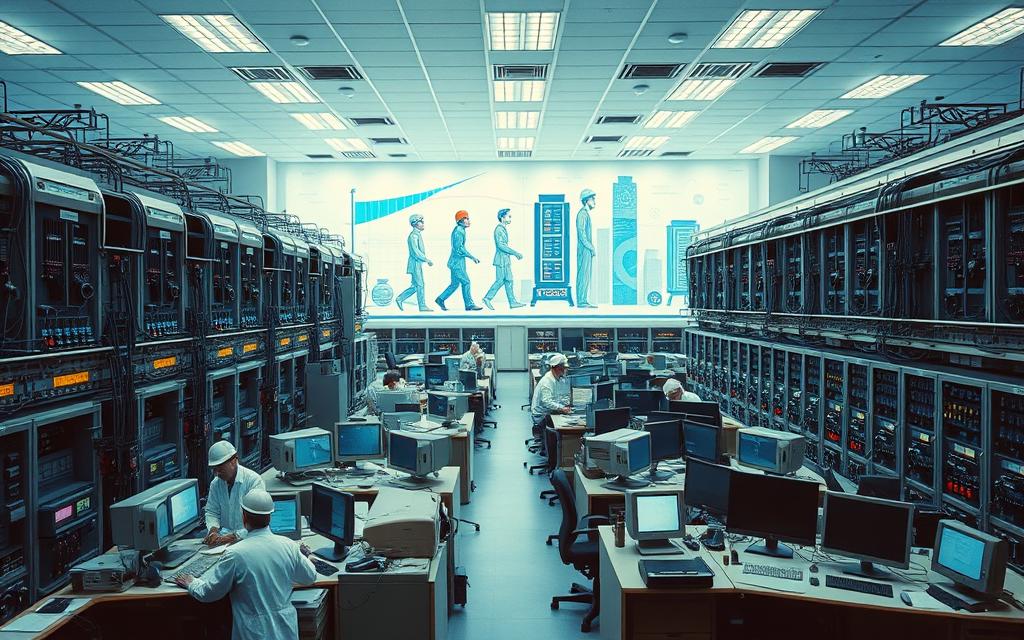
Programming languages made computers more business-friendly. COBOL, created in 1959, used English-like syntax, making programming easier.
This change brought big benefits:
- Shorter development times for business apps
- Easier upkeep of software systems
- Skills transferable between systems
The Integrated Circuit and Minicomputers
The integrated circuit, invented by Jack Kilby and Robert Noyce in 1959, changed computing. It put many components on one silicon chip.
Transistors and Semiconductor Advances
Transistors replaced vacuum tubes, bringing many improvements:
- Smaller size for compact machines
- Lower power use for cost savings
- More reliable with fewer failures
- Faster speeds for better performance
DEC PDP Series and Business Adoption
The DEC PDP series introduced minicomputers in the 1960s. These cost about £16,000, making computing affordable for smaller businesses.
The PDP-8, launched in 1965, was a big hit. Its size and price made computing accessible in various business areas.
This shift marked a key moment in corporate IT history. It started computing’s move from a centralised system to a distributed one.
The Personal Computer and Internet Revolution
The late 20th century saw a huge change in technology. The personal computer and global networks came together. This created a digital revolution that changed society, business, and daily life.
Rise of Microcomputers
The 1970s were when computers started to appear in homes. Early models like the Altair 8800 caught the interest of hobbyists. But it was the commercial versions that really started the personal computer history.
Apple II and IBM PC
In 1977, the Apple II came out with colour graphics and a built-in keyboard. It was easy to use, appealing to schools and homes. IBM followed in 1981 with their Personal Computer, setting the PC standard for years.
The IBM PC’s design allowed others to make compatible machines. This competition made computers cheaper and more powerful.
Graphical User Interfaces
Before, computers used text commands. But then, graphical user interfaces (GUIs) made them easier for everyone to use. Xerox PARC created the first GUI, but Apple made it popular with the Macintosh in 1984.
GUIs used simple ideas like desktops and folders. This made computers easy to understand, without needing to remember complex commands.
Networking and Global Connectivity
While computers became personal, networks were connecting the world. This mix sparked the internet revolution that shapes modern computing.
ARPANET to World Wide Web
ARPANET started in 1969 as a project for the military and academics. It showed how networks could survive attacks.
In the 1970s and 1980s, more networks came up, each with its own rules. The need for a common standard led to TCP/IP.
Tim Berners-Lee and HTML
In 1989, Tim Berners-Lee suggested a way to share documents at CERN. He combined HTML, URLs, and HTTP to create the World Wide Web in 1991. The web was easy to use and navigate, thanks to hyperlinks.
Software and Operating Systems
As computers got better, software became key. The fight for the best operating system changed the industry.
Microsoft Windows Dominance
Microsoft’s Windows 1.0 came out in 1985, bringing GUIs to IBM PCs. Windows 3.0 in 1990 improved performance and became popular.
Windows 95 was a hit with its Start menu and taskbar. Microsoft Windows became the top choice through partnerships with hardware makers.
Open Source and Linux
In 1991, Linus Torvalds started Linux, a free UNIX-like kernel. With GNU software, it became a full open-source system.
The open-source movement supported free development and sharing. Linux grew in popularity for servers and desktops.
This showed that community projects could rival big companies. It inspired many other software projects.
Modern IT and Future Trends
The digital world is changing fast, changing how we work and interact with tech. This section looks at the key modern IT trends shaping our world and the challenges they bring.
21st Century Technologies
Today’s IT has changed business and daily life with new innovations. These changes have altered how we store, access, and process information.
Cloud Computing and Virtualisation
Cloud computing is a big change in IT. Now, companies use remote servers for data and apps instead of physical hardware.
Virtualisation lets many virtual machines run on one server. This saves money and energy.
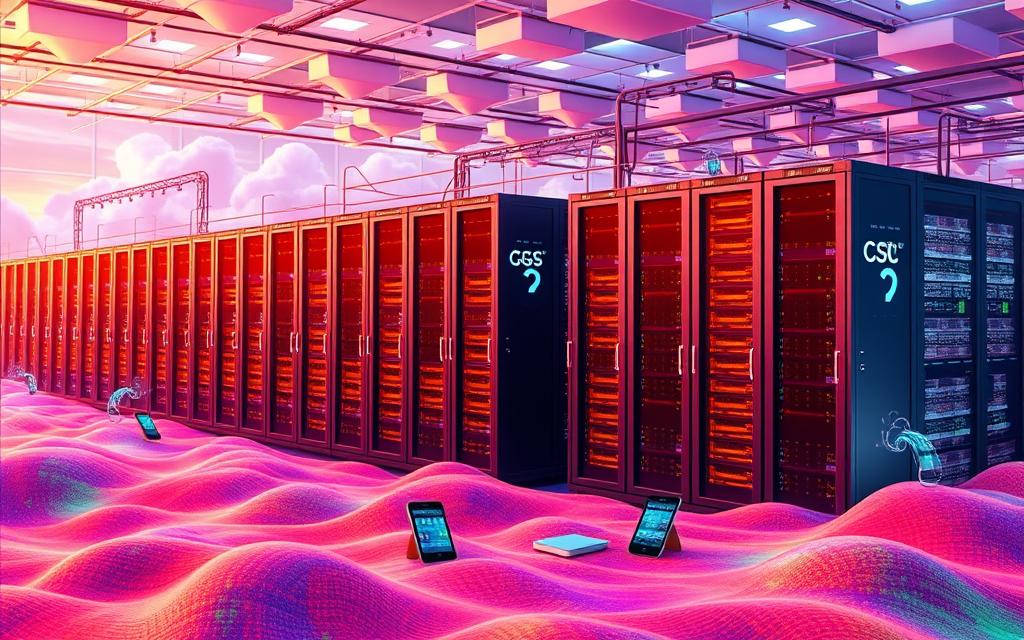
Big names like Amazon Web Services and Google Cloud Platform lead in cloud services. They offer solutions that grow with businesses.
Smartphones and Mobile IT
Mobile devices are now key to digital services for billions. In 2016, mobile browsing passed desktops, changing how we use computers.
Today’s smartphones are like powerful computers, always connected. They have apps for work, fun, and socialising.
This shift has made work and life more flexible. Businesses need to focus on mobile-friendly designs and apps.
Artificial Intelligence and Big Data
Advanced tech has opened new areas in data analysis and automation. Artificial intelligence systems now do tasks that needed human smarts before.
Machine Learning Algorithms
Machine learning is a part of AI that recognises patterns and predicts. These algorithms get better with more data, without needing to be programmed.
They’re used in things like recommending products and spotting fraud. They look at big datasets to find trends and make predictions.
Recent tech like GPT shows amazing skills in understanding language. These systems can write like humans and help with complex tasks.
Internet of Things (IoT)
The IoT connects everyday things to the internet, letting them share data and be controlled remotely. Devices with sensors send info to central systems for analysis.
Things like smart homes and health monitors are part of the IoT. They create lots of data for AI and business insights.
This network offers chances for better efficiency in many areas. But it also raises new data management and security issues.
Cybersecurity and Ethical Concerns
As tech advances, so do the challenges in keeping it safe and ethical. Digital assets are now big targets for hackers.
Data Privacy Regulations
Laws like the GDPR in Europe aim to protect personal data. They require companies to be open about how they use data and get consent.
Following these rules means investing in security and training staff. Not following them can cost a lot and harm a company’s reputation.
Future IT Challenges
Many big issues will shape IT in the future. Finding a balance between innovation and ethics is key for developers and policymakers.
AI might replace some jobs but also create new ones. We need to help workers adapt through education and policy changes.
The environmental impact of tech, like data centres and e-waste, is a big concern. We need sustainable solutions to reduce tech’s harm to the planet.
| Technology | Key Features | Primary Applications | Future Development |
|---|---|---|---|
| Cloud Computing | Scalable resources, pay-per-use model, remote access | Data storage, software hosting, disaster recovery | Edge computing, serverless architectures |
| Artificial Intelligence | Pattern recognition, predictive analytics, automation | Customer service, data analysis, content creation | Explainable AI, ethical AI frameworks |
| Cybersecurity | Threat detection, encryption, access controls | Data protection, network security, fraud prevention | AI-powered security, zero-trust architectures |
| Internet of Things | Sensor networks, real-time monitoring, automation | Smart homes, industrial monitoring, healthcare | 5G integration, improved security protocols |
The mix of these technologies brings both chances and challenges. Companies must navigate this complex world while keeping ethics and cybersecurity strong.
Success in the future depends on adapting to tech changes and addressing social concerns. The IT world is moving towards more integrated, smart, and secure systems.
Conclusion
This IT history summary shows an amazing change from old counting tools to today’s digital world. Humans have always wanted to process information. But, the big leap in the mid-20th century is one of our greatest achievements.
Technology has grown fast, thanks to Moore’s Law. Computing power has doubled every two years. Now, IT is part of our daily lives. Businesses rely on it for everything.
The future of computing looks exciting. We’re on the verge of big changes with AI, quantum computing, and always-on connections. These changes will change how we work and live. But, they also raise big questions about ethics.
The story of IT shows our endless drive to innovate. From ancient machines to today’s smartphones, each step forward has built on the last. This keeps IT at the heart of our future.
FAQ
When was the term ‘Information Technology’ first officially used?
The term ‘Information Technology’ was first used in 1958. This marked IT as a distinct field. Yet, the use of information dates back to ancient times.
What are some of the earliest known tools for recording and processing information?
Early tools include tally sticks and the abacus from Babylonia. Civilisations like the Sumerians and Egyptians used scrolls for data storage.
What is the Antikythera mechanism and why is it significant?
The Antikythera mechanism is a Greek device for astronomical calculations. It’s seen as the world’s first known analogue computer. This shows ancient origins of complex information processing.
Who were key innovators during the mechanical age of computing?
Innovators like Blaise Pascal and Joseph Marie Jacquard were key. Pascal created the Pascaline, and Jacquard’s loom was programmable. Charles Babbage and Ada Lovelace also made major contributions.
What role did Charles Babbage and Ada Lovelace play in the history of IT?
Charles Babbage designed the Difference Engine and Analytical Engine. Ada Lovelace worked on the Analytical Engine. She created the first computer programmes, making her the first computer programmer.
How did electronic computing begin to take shape in the early 20th century?
Electronic computing started with Herman Hollerith’s tabulating machine. Alan Turing’s work and ENIAC, the first electronic computer, were key. They were used in World War II.
What advancements enabled the transition from large mainframes to minicomputers?
Advances in integrated circuits and transistors made components smaller and cheaper. This led to minicomputers like the DEC PDP series. They brought computing to more businesses.
How did the personal computer and the internet revolutionise information technology?
Microcomputers like the Apple II and IBM PC, along with graphical user interfaces, changed computing. The internet, starting with ARPANET, made global connectivity possible.
What are some defining technologies and concerns in modern IT?
Modern IT includes cloud computing, virtualisation, and mobile technology. It also has artificial intelligence and the Internet of Things. But it faces challenges in cybersecurity, data privacy, and ethics.
How has information technology evolved from its ancient origins to today?
A> IT has grown from ancient tools to today’s digital systems. This journey includes mechanical calculators, early computers, and now AI and IoT. It shows exponential growth and big societal impact.